AICTE Grading Rules
The AICTE grading rules provide a standardized framework for evaluating students in technical and engineering programs across India. These rules define how grades are assigned, how SGPA (Semester Grade Point Average) and CGPA (Cumulative Grade Point Average) are calculated, and how CGPA can be converted into marks or percentage. Understanding these rules is essential for students to monitor their academic performance accurately. You can calculate CGPA, SGPA, or convert CGPA to marks quickly using the CGPA to Marks Converter or the Engineering CGPA Calculator.
What is AICTE Grading System?
The All India Council for Technical Education (AICTE) has implemented a 10-point credit-based grading system to standardize academic evaluation across engineering and technical institutes. Under this system, every course is assigned a certain number of credits, and students are graded according to their performance. Each grade corresponds to a grade point, which is then multiplied by the course credit to calculate weighted points for the semester.
This system ensures transparency, fairness, and uniformity in academic assessment across AICTE-approved institutions. It is widely used to calculate SGPA for individual semesters and CGPA for the entire academic program.
AICTE Grading Scale
The standard 10-point AICTE grading scale is as follows:
| Grade | Grade Point | Description |
|---|---|---|
| O | 10 | Outstanding |
| A+ | 9 | Excellent |
| A | 8 | Very Good |
| B+ | 7 | Good |
| B | 6 | Average |
| C | 5 | Pass |
| F | 0 | Fail |
Students are required to achieve at least a C grade to pass a course. Grades below C are considered failing, requiring a reattempt of the course.
How AICTE Calculates SGPA
The Semester Grade Point Average (SGPA) is the weighted average of grades for all courses in a semester. The formula used is:SGPA=Total Credits in Semester∑(Credit of Course×Grade Point)
Example:
| Course | Credits | Grade Point |
|---|---|---|
| Engineering Math | 4 | 9 |
| Physics | 3 | 8 |
| Programming | 4 | 7 |
SGPA=4+3+4(4×9)+(3×8)+(4×7)=1136+24+28=8.0
Your SGPA for the semester is 8.0.
You can also calculate SGPA quickly using the Engineering CGPA Calculator, which automatically computes weighted averages and provides a clear result.
How AICTE Calculates CGPA
The Cumulative Grade Point Average (CGPA) represents your overall academic performance across all semesters. It is calculated as:CGPA=Total Credits Across All Semesters∑(SGPA×Semester Credits)
Example:
| Semester | SGPA | Credits |
|---|---|---|
| 1 | 8.0 | 20 |
| 2 | 8.5 | 22 |
| 3 | 7.8 | 20 |
CGPA=20+22+20(8.0×20)+(8.5×22)+(7.8×20)=62503≈8.11
This CGPA of 8.11 reflects a student’s consistent performance across all semesters.
You can also use the CGPA to Marks Converter to convert your CGPA to percentage or marks instantly, ensuring accuracy and saving time.
Converting CGPA to Marks or Percentage
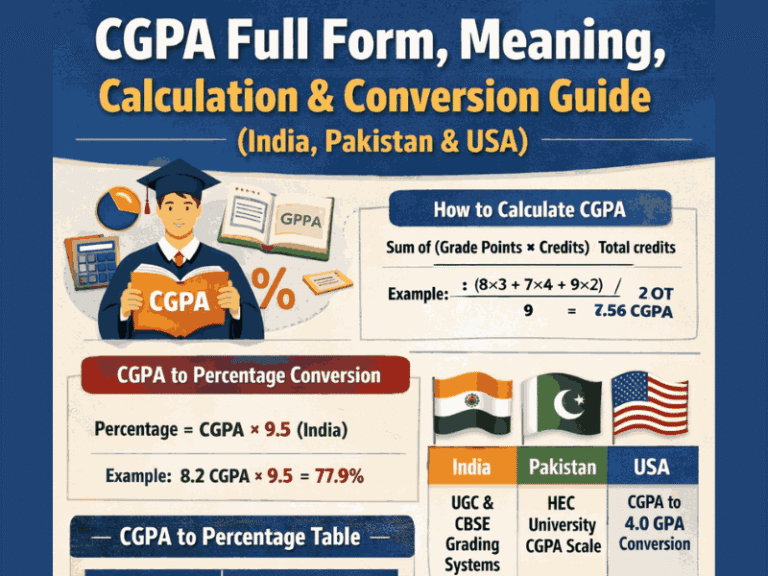
AICTE recommends converting CGPA into percentage or marks for reporting purposes. The widely used conversion formula is:Percentage / Marks=CGPA×9.5
Example:
CGPA = 8.11Marks=8.11×9.5=76.95%
This makes your academic results easier to interpret and compare, particularly for higher studies or job applications.
Practical Example Using AICTE Grading Rules
Suppose a student completes three semesters with the following performance:
| Semester | SGPA | Credits | Weighted Points |
|---|---|---|---|
| 1 | 8.0 | 20 | 160 |
| 2 | 8.5 | 22 | 187 |
| 3 | 7.8 | 20 | 156 |
CGPA Calculation:CGPA=62160+187+156=8.11
Marks Conversion:Marks=8.11×9.5=76.95%
This example highlights how AICTE grading rules standardize the calculation process, ensuring fair evaluation across all technical institutions.
Benefits of AICTE Grading Rules
- Uniformity Across Institutions: Every AICTE-approved college follows the same grading rules.
- Credit-Weighted Evaluation: Subjects with higher credits affect CGPA more, rewarding focused effort.
- Transparency: Grade points, SGPA, and CGPA calculations are standardized.
- Ease of Conversion: CGPA can be converted to marks/percentage for external evaluation.
- Academic Planning: Students can track their performance semester-wise using calculators.
Using tools like the Engineering CGPA Calculator and CGPA to Marks Converter simplifies the process and ensures precise results.
Related Tools and Articles
- How is CGPA Calculated in Engineering – Step-by-step SGPA and CGPA calculation
- Engineering CGPA Calculator – Instant semester and cumulative GPA calculation
- CGPA to Marks Converter – Convert CGPA to percentage or marks easily
These tools and guides ensure students can perform calculations accurately and plan their academic progress effectively.
Frequently Asked Questions (FAQs)
Q1: What is the AICTE grading system?
A1: AICTE grading system is a 10-point credit-based evaluation framework used in technical and engineering programs to calculate SGPA, CGPA, and marks.
Q2: How is SGPA calculated under AICTE rules?
A2: Multiply each course’s grade point by its credits, sum all, and divide by the total semester credits to calculate SGPA.
Q3: How is CGPA calculated under AICTE rules?
A3: Multiply each semester SGPA by its credits, sum all, and divide by the total credits across semesters to get CGPA.
Q4: Can CGPA be converted to percentage?
A4: Yes, the standard formula is Percentage = CGPA × 9.5. This is widely used for transcripts and job applications.
Q5: Are there tools to calculate CGPA and marks?
A5: Yes, the Engineering CGPA Calculator and CGPA to Marks Converter provide instant calculations and accurate results.
Final Thoughts
The AICTE grading rules provide a standardized and transparent system for evaluating students’ academic performance in engineering programs. By understanding SGPA, CGPA, and marks conversion, students can track progress, plan academics, and prepare for competitive exams or higher studies effectively.
Using reliable tools like the Engineering CGPA Calculator and the CGPA to Marks Converter simplifies these calculations, saving time and ensuring accuracy. Adhering to these rules also ensures students maintain a consistent academic record recognized across AICTE-approved institutions.