How to Calculate CGPA: The Ultimate Global Guide for Students
How to Calculate CGPA (India, Pakistan & US)
Navigating the academic world can feel like learning a new language, especially when universities throw around acronyms like CGPA, SGPA, and GPA. Whether you are aiming for a prestigious university admission, preparing for strict campus placements, or applying for an international scholarship, knowing exactly how to calculate CGPA is an absolute must.
But here is the catch: The rules change depending on where you live. A perfect score in India looks completely different from a perfect score in the USA or Pakistan. In this comprehensive, humanized guide, we will break down the exact formulas, provide real-life practical examples, and give you complete conversion tables for all three countries.
Let’s dive right in to demystify your academic performance!
Table of Contents
- What Is CGPA? (And Why It Matters)
- The Core Global Formula
- Step-by-Step Infographic
- How to Calculate CGPA in India (10-Point Scale)
- How to Calculate CGPA in Pakistan (4.0 Scale)
- How to Calculate CGPA in the USA (4.0 Scale)
- How to Calculate CGPA from SGPA
- Free Academic Conversion Tools
- Frequently Asked Questions (FAQs)
What Is CGPA?
CGPA stands for Cumulative Grade Point Average. Put simply, it is the overall average of the grade points you have earned across all subjects or semesters throughout your entire degree or academic program. Schools, colleges, and university admission boards use this single, powerful number to measure your consistency and overall academic brilliance.
While the fundamental concept is universal—average out your performance over time—the grading scale is heavily regional:
- India: Primarily utilizes a 10-point grading scale, heavily standardized by bodies like the CBSE and UGC.
- Pakistan & the USA: Generally rely on a credit-hour-based 4.0 grading scale.
Pro Tip: Need an instant calculation without doing manual math? Use our highly accurate and free CGPA Calculator to find your semester-wise or overall cumulative score in seconds.
The Standard Global Formula to Calculate CGPA
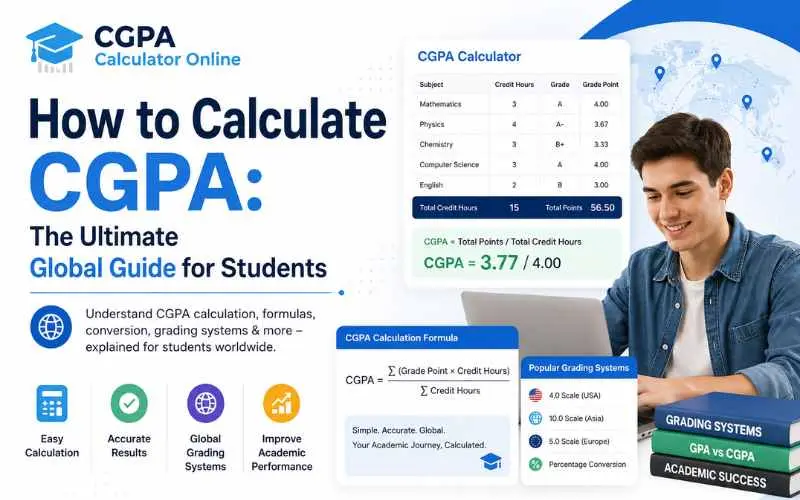
Before we explore country-specific nuances, let’s look at the standard formula utilized by most credit-based academic systems worldwide. If your university assigns “Credits” or “Credit Hours” to subjects, this is the formula they use:
In plain English: You multiply the grade you got in a class by how much that class is “worth” (credits), add all those numbers together, and divide by the total number of credits you took.
Visual Guide: How to Calculate CGPA Easily
Visualizing the process makes it incredibly easy. Follow this step-by-step roadmap to calculate your score manually:
Collect Grades
Gather the GPA or SGPA for every semester or subject.
Add Credits
Note the credit hours assigned to each specific course.
Multiply
Multiply your GPA/grade by the respective credit hours.
Sum Points
Add up all the obtained grade points together.
Divide
Divide the total grade points by the total credit hours.
Get Result
You now have your final accurate CGPA!
🇮🇳 How to Calculate CGPA in India (10-Point Scale)
If you are an Indian student, your grading system is likely governed by the CBSE Academic Grading System or the UGC India guidelines. Most institutions here use a straight 10-point scale. If your coursework doesn’t use variable credit hours, the calculation is delightfully simple.
Example Calculation (India)
Let’s say you just received your final results for 5 subjects:
| Subject | Grade Point Earned |
|---|---|
| Mathematics | 9 |
| Physics | 8 |
| Chemistry | 7 |
| English | 9 |
| Computer Science | 10 |
- Sum of Points: 9 + 8 + 7 + 9 + 10 = 43
- Number of Subjects: 5
- Calculation: 43 ÷ 5 = 8.6
Final CGPA = 8.6
Planning to study abroad and need to adapt your Indian score to an American format? Use our GPA Converter 10 to 4 tool.
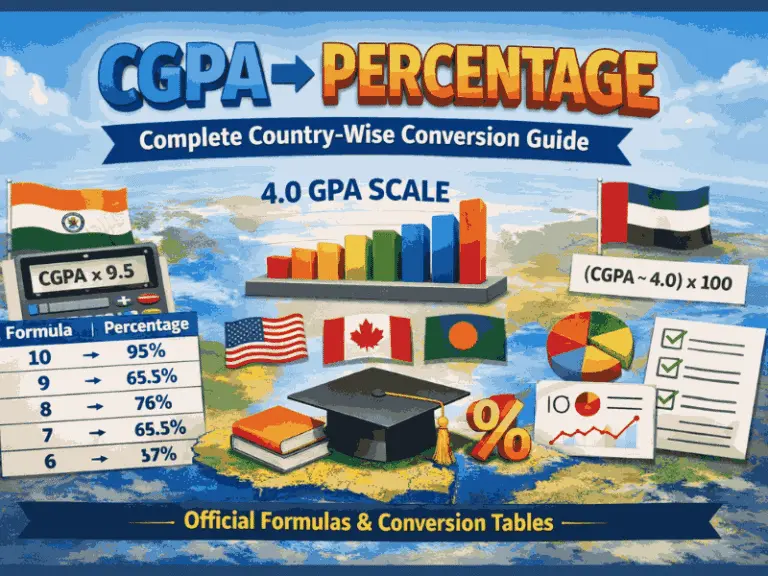
How to Convert CGPA into Percentage in India
Indian employers, traditional universities, and competitive exams often ask for your score in strict percentages. The standard CBSE conversion rule is to multiply your CGPA by 9.5. (Why 9.5? Because CBSE determined that the average marks of top scorers in the 91-100 bracket typically average out to 95, so 9.5 x 10 = 95%).
India Conversion Table: CGPA to Percentage
| CGPA (10-Point Scale) | Multiplier | Estimated Percentage |
|---|---|---|
| 10.0 | x 9.5 | 95.0% |
| 9.5 | x 9.5 | 90.25% |
| 9.0 | x 9.5 | 85.5% |
| 8.5 | x 9.5 | 80.75% |
| 8.0 | x 9.5 | 76.0% |
| 7.5 | x 9.5 | 71.25% |
| 7.0 | x 9.5 | 66.5% |
| 6.0 | x 9.5 | 57.0% |
Don’t want to do the math? Just use our CGPA to Percentage Calculator for an instant, error-free conversion. Conversely, if you have your percentage and need your grade, try our Percentage to CGPA Calculator.
🇵🇰 How to Calculate CGPA in Pakistan (4.0 Scale)
Most universities in Pakistan (such as NUST, LUMS, Punjab University, and COMSATS) follow a strict 4.0 grading system based on Higher Education Commission (HEC) frameworks. In this system, every subject has specific credit hours attached to it, meaning a 4-credit calculus class impacts your final score much more than a 2-credit elective.
Example Calculation (Pakistan)
| Course | Grade Point (Out of 4.0) | Credit Hours | Total Grade Points (GPA × Credits) |
|---|---|---|---|
| Programming Fundamentals | 3.7 | 3 | 11.1 |
| Calculus & Analytics | 3.3 | 4 | 13.2 |
| Applied Physics | 3.0 | 3 | 9.0 |
- Total Points Earned: 11.1 + 13.2 + 9.0 = 33.3
- Total Credits: 3 + 4 + 3 = 10
- Calculation: 33.3 ÷ 10 = 3.33
Final CGPA = 3.33
Pakistan Conversion Table: Percentage to CGPA (Standard Approximation)
Note: Exact mappings vary slightly by university, but this represents the standard HEC absolute grading curve.
| Percentage Range | Letter Grade | CGPA / GPA (4.0 Scale) |
|---|---|---|
| 85% – 100% | A | 4.00 |
| 80% – 84% | A- | 3.66 |
| 75% – 79% | B+ | 3.33 |
| 71% – 74% | B | 3.00 |
| 68% – 70% | B- | 2.66 |
| 64% – 67% | C+ | 2.33 |
| 61% – 63% | C | 2.00 |
| Below 50% | F | 0.00 |
Need to see what this means in strict percentage terms for a CV? Check out our GPA to Percentage Calculator.
🇺🇸 How to Calculate CGPA in the USA (4.0 Scale)
The United States educational system uses a letter-grade system that converts into a standardized 4.0 scale. This methodology is standardized by influential institutions like the College Board USA and is widely checked during admissions to Ivy League and state universities.
Example Calculation (USA)
| Course | Letter Grade | GPA Value | Credits | Quality Points (GPA × Credits) |
|---|---|---|---|---|
| Biology 101 | A | 4.0 | 3 | 12.0 |
| World History | B | 3.0 | 4 | 12.0 |
| College Algebra | A | 4.0 | 3 | 12.0 |
- Total Quality Points: 12 + 12 + 12 = 36
- Total Credits: 3 + 4 + 3 = 10
- Calculation: 36 ÷ 10 = 3.60
Final CGPA = 3.6
USA Conversion Table: Letter Grade to GPA to Percentage
| Letter Grade | Percentage Equivalent | GPA (4.0 Scale) |
|---|---|---|
| A / A+ | 93 – 100% | 4.0 |
| A- | 90 – 92% | 3.7 |
| B+ | 87 – 89% | 3.3 |
| B | 83 – 86% | 3.0 |
| B- | 80 – 82% | 2.7 |
| C+ | 77 – 79% | 2.3 |
| C | 73 – 76% | 2.0 |
| D | 65 – 69% | 1.0 |
| F | Below 65% | 0.0 |
Wondering how your cumulative score translates back to a single semester GPA format? Visit our CGPA to GPA Calculator.
How to Calculate CGPA from SGPA
SGPA stands for Semester Grade Point Average. While SGPA evaluates a single semester, your CGPA combines all of them into one master score. Many students constantly search for how to merge these numbers at the end of their degree.
(Note: This simple average method only works perfectly if all your semesters have the exact same total credit hours. If credits differ drastically per semester, you must use the credit-weight formula mentioned earlier).
Example Calculation
| Semester | SGPA Achieved |
|---|---|
| Semester 1 | 8.2 |
| Semester 2 | 8.5 |
| Semester 3 | 7.9 |
| Semester 4 | 8.4 |
- Sum of SGPA: 8.2 + 8.5 + 7.9 + 8.4 = 33
- Total Semesters: 4
- Calculation: 33 ÷ 4 = 8.25
Final CGPA = 8.25
If you want to track your individual semester performance first, rely on our accurate SGPA Calculator. Once you have your semester scores compiled, merge them effortlessly without touching a calculator by using our SGPA to CGPA Calculator.
Bookmark These Free CGPA Conversion Tools
Don’t waste time doing manual math. We have developed specialized tools tailored to exact international academic algorithms. Save these links for your next semester ends:
Frequently Asked Questions (FAQs)
Still have doubts? Here are the most common questions students ask about academic grading. (For a deep dive into the history of grading, check out Wikipedia’s guide on Grading in Education).
This depends entirely on your goals and country. Generally, a CGPA above 8.0 on a 10-point scale (India) or above 3.5 on a 4-point scale (USA/Pakistan) is considered excellent by top recruiters, Fortune 500 companies, and Ivy League universities. It shows high consistency and dedication.
No, they measure different timeframes. GPA (Grade Point Average) or SGPA (Semester Grade Point Average) represents your academic performance for just one specific semester. CGPA measures your overall academic performance accumulated across your entire degree program.
Absolutely. Utilizing a digital tool like our CGPA Calculator saves time and completely removes human mathematical errors. None of your academic data is saved on our servers, ensuring total privacy.
While the CBSE standard is 9.5, some specific autonomous universities in India (like certain NITs or private colleges) advise students to multiply their CGPA by 10 to get the percentage. Always check your university’s official examination cell guidelines written on the back of your transcript to confirm your specific multiplier.