University of Cambridge Acceptance Rate for International Students
University of Cambridge Acceptance Rate
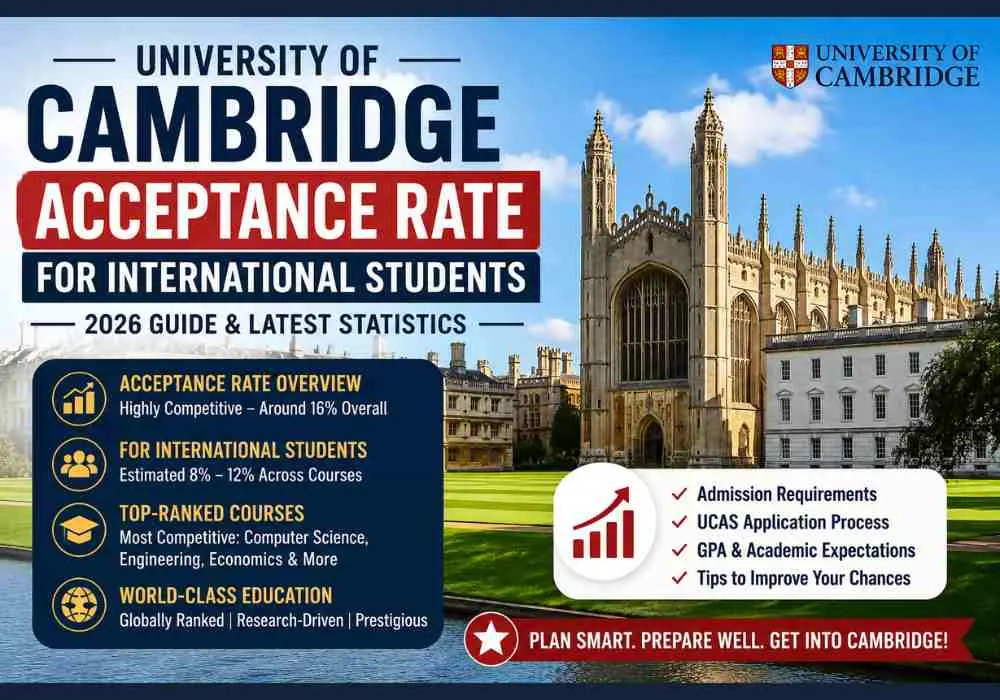
Quick Answer: The current overall University of Cambridge acceptance rate is approximately 16.3%. For overseas applicants, the Cambridge acceptance rate for international students ranges from 11% to 15.4% depending on the specific course and college. Admission requires near-perfect academic credentials, such as A*A*A at A-Level or a 3.9+ GPA paired with five AP scores of 5. International students do not face specific quotas or disadvantages for most subjects (except Medicine), but they compete within a highly self-selecting global talent pool. You can estimate your specific baseline alignment using our Cambridge Admission Chances Calculator.
| Cambridge Admission Metric | 2024-2026 Snapshot Data |
|---|---|
| Overall Acceptance Rate | ~16.3% |
| International Acceptance Rate | 11% – 15.4% |
| Undergraduate Population | ~12,940 |
| Postgraduate Population | ~11,330 |
| International Student Share | ~25% of Total Enrollment |
| Location | Cambridge, United Kingdom |
| QS World Ranking (2025/2026) | Top 5 Globally |
Cambridge Admission Pro Tips
- Academics outweigh extracurriculars. The admissions committee looks for “super-curricular” engagement—evidence of deep, independent study in your specific subject area rather than general sports or volunteer work.
- Subject-specific preparation decides outcomes. You apply to a specific course (Tripos), not the university at large. Your entire profile must demonstrate high-level competency in that single field.
- Admissions tests act as the primary filter. High grades are expected from everyone. Scores on the ESAT, TMUA, or LNAT determine who gets an interview.
- A high GPA is just the baseline. Securing top grades gets your application read. The academic interview—designed to test how you solve unfamiliar problems—determines your acceptance.
- International students need a 12-to-18-month timeline. Managing visa regulations, language testing, and the strict October 15 UCAS deadline requires early planning.
Evaluating the Cambridge Admissions Landscape
The University of Cambridge stands among the most academically rigorous institutions globally. Because of its prestige, prospective students constantly search for the university of cambridge acceptance rate for international students to set realistic expectations.
Unlike North American universities that look at a student’s holistic background, Cambridge operates purely on academic merit. The collegiate system means applicants apply through a specific College (such as Trinity College Cambridge or St John’s College) for a distinct degree course. If you want to study Economics, every part of your application must prove your mathematical aptitude and economic reasoning.
A broad look at the university’s acceptance rate fails to capture the nuance of this system. Certain degrees admit one in five applicants, while others admit fewer than one in twelve. The material below breaks down exact entry requirements, GPA expectations, and structural differences in the application process so you can build a highly targeted strategy.
1. University of Cambridge Acceptance Rate (2026): Admission Statistics & Trends
Official university data offers transparency into the exact volume of applicants and successful enrollments. During a typical recent admissions cycle, Cambridge processed roughly 22,150 applications for undergraduate programs.
From this total, the admissions tutors made about 4,760 conditional offers. A conditional offer requires the student to achieve specific final grades (like finishing their A-Levels with A*A*A) before the placement is secured.
After final exam results are published, roughly 3,630 students meet their conditions and enroll. This translates to two critical percentages:
- Offer Rate: ~21.4% (The percentage of students receiving a conditional offer).
- Final Acceptance Rate: ~16.3% (The percentage of students who successfully enroll).
| Admissions Cycle | Applications | Offers Made | Offer Rate | Final Acceptances | Acceptance Rate |
|---|---|---|---|---|---|
| 2024 / 2025 | 22,153 | 4,760 | 21.4% | 3,632 | 16.3% |
| 2023 | 21,445 | 4,553 | 21.2% | 3,557 | 16.6% |
| 2022 | 22,470 | 4,238 | 18.9% | 3,544 | 15.8% |
On paper, a 16.3% rate appears higher than the single-digit rates of Ivy League universities. However, the UK university system strictly limits how many schools a student can apply to. Applicants are restricted to five choices on UCAS, and they cannot apply to both Oxford and Cambridge in the same year. Consequently, only students performing at the very top of their national education systems even attempt an application, making the applicant pool incredibly concentrated.
2. University of Cambridge Acceptance Rate for International Students
For candidates applying from outside the UK, the exact university of cambridge acceptance rate for international students sits lower than the domestic average. Recent cycles show over 7,600 overseas applications, resulting in around 1,180 final admissions. This puts the international acceptance rate between 11% and 15.4%.
This variance occurs for two specific reasons. First, a high volume of applications comes from heavily populated regions like China and the United States, creating intense competition for a finite number of college placements. Second, some international qualifications do not map cleanly to the British A-Level standard. Students using non-standard curriculums may struggle to meet the strict conditions of their offers.
To ensure your grades align with international standards before applying, checking your local scores against UK requirements via a study abroad CGPA guide provides clarity on whether you meet the academic threshold.
A look at regional representation reveals distinct patterns:
- China: ~10.7% acceptance rate. High application volume specifically concentrated in STEM and Engineering.
- United States: ~24% acceptance rate. U.S. applicants who apply typically hold multiple AP scores of 5, providing Cambridge with clear, standardized academic metrics.
- India: ~12.2% acceptance rate. Intense competition from students presenting CBSE/CISCE scores in the 95th percentile.
- Singapore: Generally higher success rates because the Singapore-Cambridge GCE A-Level system perfectly matches the university’s evaluation methods.
3. How Hard Is Cambridge to Get Into?
Acceptance percentages do not fully explain how demanding the process is. Cambridge utilizes a multi-stage elimination system.
First, academic sorting removes candidates lacking the required grades. A single B in a relevant subject often results in immediate rejection. Second, candidates must sit for highly specialized admissions assessments. These timed exams (like the TMUA for math-based subjects or the LNAT for Law) evaluate problem-solving under pressure rather than memorization.
The final and most rigorous barrier is the academic interview. Cambridge interviews approximately 75% of applicants. You sit with leading academics in your field who will give you a problem to solve out loud. They want to see how you react when you don’t know the answer. If you can take a hint, adapt your logic, and work through a complex thought process, you demonstrate the capacity to succeed in Cambridge’s small-group teaching system (supervisions).
4. Acceptance Rate by Course
The Tripos (degree course) you select dictates the level of competition. High-demand fields like Computer Science reject over 90% of applicants. Niche humanities subjects with specific language requirements often show statistically higher acceptance rates, simply because the pool of qualified applicants is smaller.
| Cambridge Course | Approximate Acceptance Rate | Competitiveness |
|---|---|---|
| Computer Science | 7.6% – 9.3% | Extreme |
| Economics | 10.2% – 13.7% | Very High |
| Medicine (Undergraduate) | ~15.1% | Very High (Stricter for internationals due to caps) |
| Engineering | 12.1% – 15.4% | High |
| Law | 14.6% – 17.7% | High |
| Mathematics | 14.1% – 16.2% | High (Requires STEP papers) |
| Natural Sciences | 20.0% – 22.5% | Moderate to High |
| History | 25.0% – 28.0% | Moderate |
| Classics / Modern Languages | 40.0% – 48.0% | Accessible (Requires exact subject background) |
5. University of Cambridge MBA Acceptance Rate
Postgraduate admissions follow an entirely different framework. Professionals researching the university of cambridge mba acceptance rate apply directly to the Cambridge Judge Business School rather than through UCAS.
The Cambridge MBA acceptance rate usually hovers around 31%. The cohort sizes are kept small to maintain a high-quality networking environment. To secure a place, applicants typically need:
- GMAT Performance: A class average of 690 (classic GMAT) or a highly competitive GMAT Focus Edition score.
- Professional Trajectory: At least 3 years of work experience, with the class average closer to 6 years, highlighting leadership and global impact.
- Undergraduate Academics: A strong bachelor’s degree equivalent to a UK 2:1 or a US GPA of 3.5+.
6. Entry Requirements for International Students
Cambridge requires international applicants to demonstrate achievement equivalent to the highest A-Level grades (A*AA or A*A*A). Requirements vary based on local education systems.
United States
A standard US high school diploma is insufficient. Cambridge expects a minimum of five Advanced Placement (AP) exams with scores of 5 in subjects closely related to the intended major. To track how your AP scores position you, use our AP Exam Professional Score Calculators. High SAT (1500+) or ACT (33+) scores are standard among admitted students.
India
Students taking the CBSE or CISCE Class 12 board exams must achieve 90% to 95% across five core subjects, with the highest marks concentrated in subjects relevant to the degree course.
Pakistan
Direct entry usually requires completion of British A-Levels with top grades. The local Matriculation/Intermediate system rarely satisfies direct entry requirements, meaning students often need to take a foundation year or complete one year of university study first.
Canada
Evaluation depends on the provincial system. For students in Ontario (OSSD), Cambridge expects an overall average of 90% to 95% across six Grade 12 U/M courses. If you are converting Canadian grades for broader application tracking, the WES GPA Calculator helps standardize these percentages.
Australia & Singapore
Australian students need an ATAR of 98.5 to 99.5+. Singaporean applicants presenting Singapore-Cambridge GCE A-Levels typically need AAA at the H2 level.
Language Proficiency: Non-native speakers must pass an English language test, typically requiring an IELTS Academic score of 7.5 overall (no element below 7.0) or a TOEFL iBT of 110 (no element below 25).
7. GPA and CGPA Requirements for Cambridge
Cambridge assesses applications based on standardized exit exams rather than continuous GPA. However, U.S. applicants often ask, “What GPA is required for Cambridge?”
An unweighted GPA between 3.9 and 4.0 is standard. Because educational systems calculate cumulative grades differently, understanding your baseline is necessary. You can use our CGPA Calculator to aggregate your current transcripts. If your school uses unique weighting, reading How to Calculate CGPA ensures you report your academic standing accurately on international forms.
8. How to Improve Your Academic Profile Before Applying
If your early high school grades contain inconsistencies, you must show upward trajectory before the October deadline.
- Take Advanced Level Courses: Enroll in the hardest classes available (IB HL, APs, or A-Levels). Use a Semester GPA Calculator to monitor term-by-term performance in these rigorous subjects.
- Strategic Retakes: Cambridge prefers candidates who secure top marks on their first attempt. However, if a documented issue caused a low grade early on, retaking the class shows commitment. A Retake GPA Calculator helps determine if the new score sufficiently lifts your average.
- External Testing: Winning national olympiads or scoring highly in university-level math competitions provides objective proof of your ability, bypassing local grading inconsistencies.
9. UCAS Application Process Explained
All undergraduate applications route through UCAS. The Cambridge deadline is October 15th, a full three months before the standard UK university deadline.
The primary component is the Personal Statement (4,000 characters). A Cambridge personal statement differs entirely from a US admissions essay. It must focus intensely on academic exploration. Detail the specific books you read, the mathematical theories you researched, or the scientific models you built. Avoid spending space on sports or general leadership unless it directly applies to your degree.
While Cambridge relies on exact grades rather than tariff systems, other UK universities on your list might use points. You can evaluate your total score using a UCAS Points Calculator for your backup options.
10. Actionable Roadmap for International Applicants
Securing an offer requires a structured timeline:
- Years 9–11: Establish flawless foundational grades. Align your subject choices perfectly with your intended university course.
- Year 12: Begin super-curricular reading. Draft your personal statement over the summer.
- August–September (Year 13): Register for your specific Cambridge admissions test (e.g., LNAT, ESAT). Finalize your UCAS application.
- October 15: Submit the UCAS application. Shortly after, complete the supplementary “My Cambridge Application” questionnaire.
- November–December: Sit for admissions tests and attend the academic interview if shortlisted.
- January: Receive the final decision (offer, pool placement, or rejection).
11. Oxford vs Cambridge Acceptance Rate: Which Is Harder to Get Into?
Because UCAS rules prevent applying to both Oxford and Cambridge in the same year, international students must choose one. While both have similar overall acceptance rates (14%–17%), their internal filtering mechanisms differ.
| Metric | University of Cambridge | University of Oxford |
|---|---|---|
| Overall Acceptance Rate | ~16.3% | ~14.5% |
| Interview Shortlisting | Interviews a large percentage (~75%) | Interviews a smaller percentage (~30-40%) |
| Filtering Method | Relies heavily on the interview to decide final offers. | Uses pre-admissions tests to aggressively cut the applicant pool early. |
If you perform exceptionally well on written exams but experience anxiety during live discussions, Oxford’s heavy reliance on pre-tests might favor you. If you thrive in academic debate and can articulate complex thoughts clearly in person, Cambridge’s wider interview net offers a stronger opportunity.
12. Related University Acceptance Rate Guides
Relying solely on a Cambridge application carries high risk. Building a balanced list of global universities ensures you secure a top-tier placement. Compare acceptance metrics across other institutions:
- University of Cambridge Acceptance Rate
- University of Oxford Acceptance Rate
- Harvard Acceptance Rate
- Stanford Acceptance Rate
- MIT Acceptance Rate
- University of Toronto Acceptance Rate
- National University of Singapore Acceptance Rate
13. Study Abroad Academic Preparation Tools
Applying internationally means adjusting to different credit systems. If you plan to apply to universities across multiple continents as a backup to Cambridge, these tools help standardize your records:
- For European university options that use the Bologna Process, use the GPA to ECTS Credits Calculator.
- For North American institutions requiring verified grade translations, the WES evaluation format is standard.
14. Common Reasons International Students Get Rejected
Even valedictorians receive rejections from Cambridge. Analyzing past rejection trends highlights specific errors:
- Generic Personal Statements: Applying for “Science” instead of specifically addressing the Natural Sciences Tripos structure.
- Weak Test Scores: Perfect A-Levels cannot compensate for a low score on the TMUA or LNAT.
- Interview Rigidity: Candidates who memorize answers rather than adapting their logic when professors introduce new variables during the interview.
- Missed Deadlines: Failing to register for pre-interview assessments or missing the October 15 UCAS deadline.
Key Takeaways: Quick Facts
- Current Acceptance Rate: The undergraduate acceptance rate is roughly 16.3%.
- International Competition: Overseas applicants experience an acceptance rate of 11% to 15.4%.
- GPA Expectations: US students need a 3.9+ GPA and five AP exam scores of 5.
- MBA Admissions: The Cambridge Judge Business School accepts approximately 31% of MBA applicants, requiring strong GMAT scores and professional experience.
- Selection Focus: Admissions tutors prioritize subject-specific academic excellence, admissions test scores, and interview performance above all extracurriculars.
Frequently Asked Questions
1. Is Cambridge harder to get into than Harvard? +
2. Is a 3.8 GPA enough for Cambridge? +
3. Does Cambridge prefer IB or A-Levels? +
4. Can Pakistani students apply to Cambridge? +
5. Can Indian students get into Cambridge? +
6. What IELTS score does Cambridge require? +
7. Which Cambridge college is easiest to get into? +
8. What subjects are most competitive? +
9. Do I need SATs for Cambridge? +
10. What is the winter pool? +
11. Does Cambridge accept transfer students? +
12. Are admissions blind to nationality? +
13. Can I apply to both Oxford and Cambridge? +
14. Does Cambridge offer financial aid for international students? +
15. What is the typical ATAR required for Australian students? +
16. What happens during a Cambridge interview? +
17. Does Cambridge accept retakes? +
18. What are super-curricular activities? +
19. Can I defer my Cambridge offer? +
20. What is the acceptance rate for Natural Sciences? +
21. Do I apply to a specific major? +
22. What is STEP? +
23. How important are teacher references? +
24. Are extracurriculars like sports considered? +
25. When do Cambridge admission decisions come out? +
Commitment to Admission Accuracy
The research team at cgpacalculatoronline.net compiles educational data to support international students in making informed academic decisions. The statistics, GPA conversions, and strategic advice outlined above originate directly from official university data cycles, UCAS reporting standards, and recognized international qualification frameworks. Because institutional policies update annually, applicants must cross-reference their specific academic standing with the primary university portals prior to submitting formal applications.